1. Background
The Full Active Suspension System consists of perception, control, and actuation components.
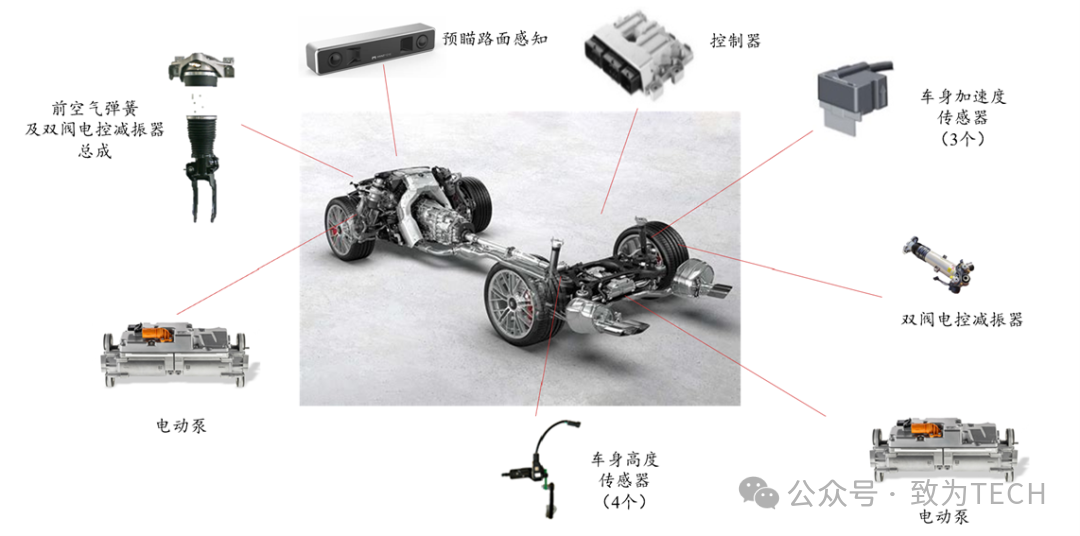
The main functions of the Full Active Suspension System include:
Actively isolating uncomfortable vibrations to improve ride comfort; suppressing body roll during steering and lane changes; suppressing body pitch during braking and acceleration; rapidly raising the vehicle body to improve passability; improving the RTI value and the path-following performance of off-road vehicles; and enhancing overall vehicle quality through personalized functions.
Full Active Suspension Systems primarily use hydraulic or electromechanical configurations. A hydraulic configuration typically comprises an Electric Hydraulic Pump, a dual-valve CDC damper, and other components.
2. Key Technologies for Full Active Hydraulic Suspension System Development
2.1 Physical Modeling and External-Characteristic Representation
A full active hydraulic suspension comprises a dual-valve electronically controlled damper and an Electric Hydraulic Pump connected in parallel through the hydraulic circuit. The damper's rebound and compression damping are independently controlled by separate electronically controlled valves. The Electric Hydraulic Pump comprises an internal gear pump, a permanent-magnet synchronous motor, and a controller, with a pressure sensor used to measure internal pressure.
A physical-structure-based model is developed in Simulink, covering components such as the damper working cylinder, electronically controlled damping valves, and accumulator to represent the external characteristics of the dual-valve damper.
The internal gear pump model uses geometric parameters to construct a flow model and describes pressure changes in the suction chamber, transition chamber, discharge chamber, and trapped-oil chamber. It is used to analyze pressure-pulsation and flow-pulsation characteristics.
Based on pressure and flow balance within the Full Active Suspension System, the damper model and internal gear pump model are connected in parallel to form a combined system model that represents the system's external characteristics.
2.2 Control Software and Simulation Environment
(1) Simulation Environment Development
After the single-wheel Full Active Suspension model is encapsulated, a CarSim and MATLAB/Simulink co-simulation model can be established for Full Active Suspension System control software development.
(2) Heave Vibration-Control Software Development
The active force generated by the hydraulic pump and the damping force generated by the electronically controlled damper are coupled. Active-force control and damping-force control must therefore be designed collaboratively and calibrated according to the specific control strategy.
(3) Roll-Control Software Development
Roll control covers three dimensions: steady-state body roll-angle control, dynamic agility and handling control, and ride-comfort control under road excitation. The target roll moments for the front and rear axles are ultimately distributed to the actuators at each wheel through interaction forces between the left and right wheels.
(4) Pitch-Control Software Development
Pitch control uses the vehicle's pitch angle as the body-attitude control target.
Summary
Physical-structure-based Full Active Suspension System modeling and external-characteristic representation provide an important foundation for production-vehicle software development and tuning. High-fidelity physical simulation models can be used to predict and analyze system characteristics.
A CarSim and Simulink co-simulation environment supports Full Active Suspension System control strategy software development and helps define key software architectures and control strategies, including integrated active and semi-active heave-vibration control and roll control.